
Alain Le Bot - Portrait

Tribology and System Dynamics Laboratory - CNRS

Ecole Centrale de Lyon

36, avenue Guy de Collongue, 69134 Ecully, FRANCE

Phone: +33 4 72 18 62 75

Email: alain.le-bot@ec-lyon.fr

Vibroacoustics

Vibroacoustics

Vibroacoustics is the study of structural vibrations, acoustics, and the interaction between vibrations and sound.

The phenomena are rich and varied. However, it is customary to classify them as follows:

1. Wave propagation and acoustics
2. Reflection, diffraction and absorption of waves at boundaries
3. Sound transmission through structures
4. Acoustic radiation of structures
5. Structural response to acoustic excitation

Each title is the subject of a chapter in vibroacoustics courses and textbooks.

Here is an example of the formulation of a vibroacoustics problem. The problem is in two dimensions. We consider a structure (plate) whose transverse displacement at any time is v(x,t), in interaction with a fluid medium where an acoustic pressure field p(x,y,t) propagates. The reference frame is specified by the figure below.
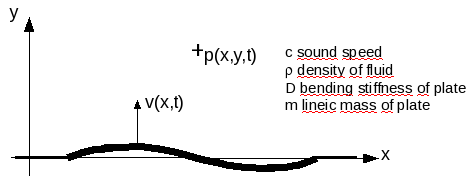
Two-dimensional vibroacoustics problem

Example of a two-dimensional vibroacoustics problem. The fluid is present in the domain y>0 and the structure is at y=0.

The acoustic wave (linear regime without flow) is governed by the wave equation,

\[ \frac{\partial^2 p}{\partial x^2} - \frac{1}{c^2} \frac{\partial^2 p}{\partial t^2} = 0 \]

where c is the speed of sound.

The transverse displacement v(x,t) of the structure follows Love's equation adapted to the dynamics of a thin plate in bending vibration,

\[ D\frac{\partial^4 v}{\partial x^4} - m \frac{\partial^2 v}{\partial t^2} = -f(x,t) \]

D is the stiffness of the plate and m is its mass per unit length. f(x,t) is the structural force field applied to the plate. This is what is responsible for the vibration.

Finally, the coupling conditions between the fluid medium (acoustic) and the structure (Love plate) translate the continuity of velocities at the surface of the structure,

\[ \frac{\partial p}{\partial y} + \rho \frac{\partial^2 v}{\partial t^2} = 0 \]

where rho is the density of the fluid.

Boundary conditions must be added for both the fluid and the structure, as well as initial conditions (fluid and structure) to mathematically close the problem. The set of equations (1), (2) and (3), boundary conditions and initial conditions form a vibroacoustics problem.

All the phenomena of vibroacoustics are contained in this system of partial differential equations. Solving this system analytically is only possible in a few rare cases. These give rise to very technical calculations often relying on intensive use of complex analysis.
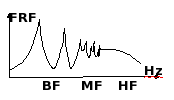
The three frequency bands

For each vibroacoustics problem, we can define three frequency ranges: low, medium, and high frequencies.

Three frequency ranges: low, medium, high

The three frequency ranges are: low frequencies (LF) where modes are few and well separated, medium frequencies (MF) an intermediate zone, high frequencies (HF) where modes are numerous and indistinguishable.

There are several ways to define frequency ranges. Here is one adapted to the discussion on this site:

1. Frequencies are low when the wavelength of vibration or the acoustic wavelength is greater than or of the same order of magnitude as the size of the system considered.
2. Medium frequencies form an intermediate zone.
3. High frequencies are the domain where the wavelength is small compared to the size of the system.

Note that the concept of low or high frequencies depends on the size of the system (high frequencies start at a few kilohertz for a small living room and at a few hundred hertz for an auditorium). They also depend on the structure of the system (a flexible structure reaches high frequencies more quickly than a rigid structure).

frequency 100 Hz 1 kHz 10 kHz
acoustic wavelength (air) 3 m 30 cm 3 cm
structural wavelength - steel plate 1 mm 30 cm 10 cm 3 cm
structural wavelength - steel plate 10 mm 1 m 30 cm 10 cm
Order of magnitude of acoustic wavelengths in air and structural wavelengths in a steel plate. The wavelength depends on the thickness of the plate.

Numerical methods

The numerical methods usually employed to solve the differential equations of vibroacoustic coupling are as follows:

1. The finite element method. This is the most widespread method. It is well suited to finite systems such as structures or closed rooms.
2. The boundary element method. This is a less widespread method but is better suited in the case of unbounded systems such as free-field radiation.
3. Mixed method: finite elements for the bounded structure and boundary elements for the acoustic part.
4. Ray tracing. This is a widespread method in room acoustics for solving high-frequency problems under the geometric acoustics hypothesis.