
Alain Le Bot - Portrait

Tribology and System Dynamics Laboratory - CNRS

Ecole Centrale de Lyon

36, avenue Guy de Collongue, 69134 Ecully, FRANCE

Phone: +33 4 72 18 62 75

Email: alain.le-bot@ec-lyon.fr

Multicontact Interface

Multicontact interface

A surface is never perfectly plane. This reality has probably been known for a very long time, maybe several thousands of years. But in mechanics, especially in the theory of elasticity, the surfaces are most often idealized as perfect planes, cylinders, spheres... This is under this strict simplication that closed-form solutions may be found in contact mechanics.

But several phenomena cannot be explained within the framework of this paradigm. Dry rubbing is one of them. And in the following pages, we shall explore one of its consequences, the friction sound.

Friction is a force that resists the sliding of two bodies in contact. In the eighteenth century, Coulomb attributed the cause of dry friction to the penetration of asperities in the antagonist surface.

Coulomb's explanation of friction

Explanation of friction by Coulomb. Asperities interpenetrate so that the upper solid sliding requires asperities of lower solid to jump.

The direct observation of the non-flatness of surfaces is relatively recent. Modern mechanical and optical devices allow to explore surfaces from millimetric to nanometric scales. It can be seen that a surface is like mountains with summits and valleys. The only difference is that usually slopes of peaks are small, commonly about ten to twenty percents. In the following figure the vertical scale is exaggerated so that it appears like sharp peaks.
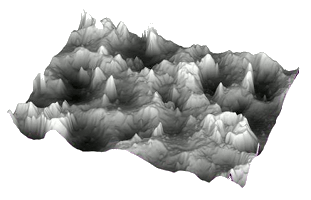
Surface of a metallic sample at the micrometric scale

Surface of a metallic sample at the micrometric scale.

Now, when two solids are put into contact, we must imagine two mountain chains, one being turned upside down the other. Higher peaks touch the antagonist surfaces but most of valleys do not enter into contact. Three consequences appear as a result.

First, the contact is broken up. It is composed of numerous spots distributed on the surface. Second, the contact is rare. The actual contact area is usually a very small part of the nominal contact area. Third, the contact is random. The evidence of randomness is highlighted with the notion of correlation length. The distribution of asperity height is also an essential element of randomness.

On the following figure, we see a contact between a piece of elastomer in contact with a flat glass. Although the elastomeric sample seems to be flat at first sight, at the microscopic scale appear numerous spots (red).
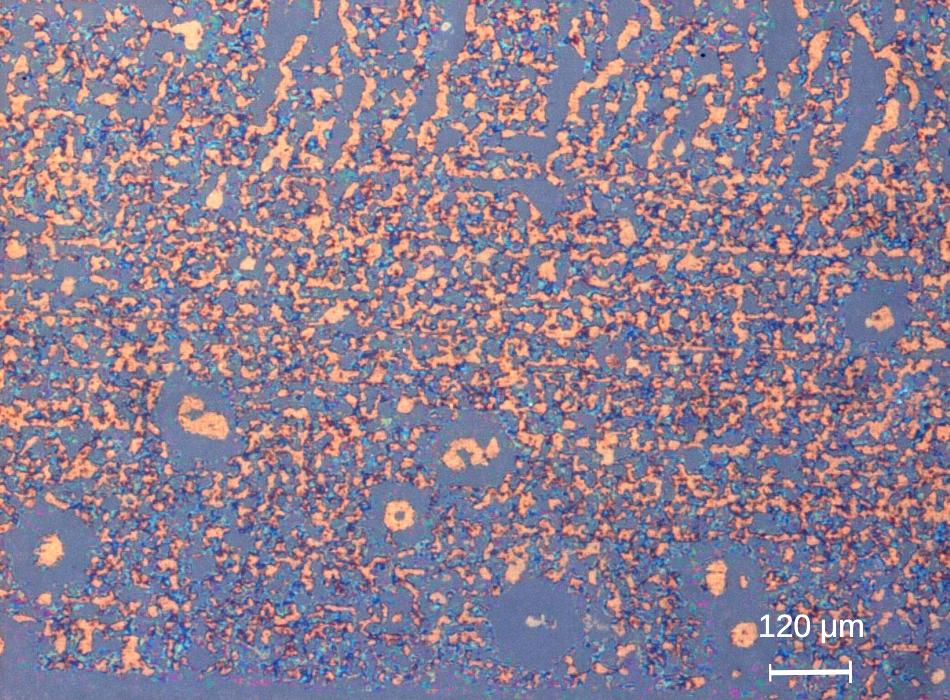
View of contact between glass and elastomer

View of contact between glass and elastomer, the contact spots are colored in red (from F. Deleau's thesis).

Greenwood and Williamson theory

In the Greenwood and Williamson theory, the asperities are considered as a random population. The height of asperity \(h\) is a random variable whose probability density function is noted \(p(h)\). The problem consists in searching the condition for an asperity to be in contact with another solid.

The canonical situation is shown in the following figure. The rough surface of a solid is composed of elastic spheres. The spheres are randomly distributed over the surface. Their altitudes are also random. A rigid plane is located above the spheres.

R Δ R h<Δ h>Δ

Figure 1: Population of spheres of same radius \(R\) and random altitude \(h\) in contact with a plane at altitude \(\Delta\).

The surface area of the solid is noted \(S\) and the number of spheres \(n\). The distance between the reference of altitudes and the plane is \(\Delta\).

We use the following assumptions:
  • The spatial distribution of spheres is uniform with density \(n/S\).
  • The altitudes \(h_i\), \(i=1,\dots,n\) of the spheres are independent random variables of same probability density \(p(h)\).
  • All spheres have same radius \(R\).
  • The spheres are elastic with Young's modulus \(E\).
  • The contact between a sphere and the plane follows Hertz' law.

A sphere is in contact with the upper plane if \(h>\Delta\). But the population contains \(n\) spheres of altitudes \(h_1,\, h_1, \dots, h_{n}\). The number of contact spots is the number of variables \(h_i\) greater than \(\Delta\). We write it

\[ N=\sum_{i=1}^{n} \mathrm{H}(h_i - \Delta) \]

where \(\mathrm{H}\) denotes de Heaviside function. So the expectation of number of spots is

\[ \langle N \rangle = \int_{\mathbb{R}^n} \sum_{i=1}^{n} \mathrm{H}(h_i - \Delta) p(h_1,\dots,h_n) \, dh_1 \cdots dh_n \]

where \(p(h_1,\dots,h_n)\) is the joint probability density function of the variables \(h_i\). But the altitudes \(h_i\) are assumed to be mutually independent. This reads \(p(h_1,\dots,h_n)=\prod_{i=1}^n p(h_i)\). Substituting gives

\[ \langle N \rangle = \sum_{i=1}^{n} \int_{\mathbb{R}^n} \mathrm{H}(h_i - \Delta) p(h_1) \dots p(h_n) \, dh_1 \cdots dh_n \]

Separating the \(n\)-uple integral in a product of \(n\) integrals yields

\[ \langle N \rangle = \sum_{i=1}^{n} \int_{-\infty}^\infty p(h_1) \, dh_1 \cdots \int_{-\infty}^\infty \mathrm{H}(h_i - \Delta) p(h_i) \, dh_i \cdots \int_{-\infty}^\infty p(h_n) \, dh_n \]

But by normality \( \int p(h) \, dh =1\).

\[ \langle N \rangle = \sum_{i=1}^{n} \int_{-\infty}^\infty \mathrm{H}(h_i - \Delta) p(h_i) \, dh_i \]

And finally, the expectation of spot numbers is

\[ \langle N \rangle = n \int_\Delta^\infty p(h) \, dh \]

The second quantity of interest is the contact area. By the argument of independence as above, the expectation of contact are of \(n\) spheres is \(n\) times the expectation of contact area of a unique sphere. In Hertz' theory of elastic sphere/plane contact, the surface of contact is a disk of radius \(a = \sqrt{R\delta}\) where \(\delta\) is the depth of penetration. Therefore, the contact area of a sphere of altitude \(h_i>\Delta\) is \(A_i=\pi R (h-\Delta)\) while that of altitude \(h_i<\Delta\) is zero. So, the expectation of surface area \(A=\sum_i A_i\) of the \(n\) spheres is

\[ \langle A \rangle =n \int_\Delta^\infty \pi R (h-\Delta) p(h) \, dh \]

The third and last quantity of interest is the normal load applied to the solid to maintain the contact. In Hertz' theory, the load is \(4/3 \times \sqrt{R} E \delta^{3/2}\) for a depth of penetration \(\delta\) and Young's modulus \(E\). Therefore the load applied on a sphere is \(W_i=4/3 \times \sqrt{R} E (h_i-\Delta)^{3/2}\) when \(h_i>\Delta\) and zero otherwise. Finally, the expectation of total load \(W = \sum_i W_i\) for the \(n\) spheres is

\[ \langle W \rangle =n \int_\Delta^\infty \frac{4}{3} \sqrt{R} E (h-\Delta)^{3/2} p(h) \, dh \]

Bibliography

  1. C.A. Coulomb, Théorie des machines simples, Librairie Bachelier, Quai des Augustins, Paris, 1821, Reprint Albert Blanchard Paris, 2002.

  2. F. Deleau, D. Mazuyer, A. Koenen, Sliding friction at elastomer/glass contact: Influence of the wetting conditions and instability analysis, Tribology International, vol. 42, p. 149-159, 2009.

  3. J.A. Greenwood, J.B.P. Williamson, Contact of nominally flat surfaces, Proc. R. Soc. 295, 1966.

  4. K.L. Johnson, Contact mechanics, Cambridge university press, 1985.

  5. F. Wu-Bavouzet, J. Cayer-Barrioz, A. Le Bot, F. Brochard-Wyart and A. Buguin, Effect of surface pattern on the adhesive friction of elastomers, Physical Review E, vol. 82, 031806, 2010.