Tyre model
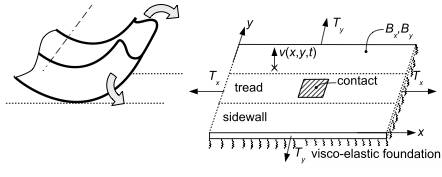
A tyre is a thin visco-elastic shell whose edges are fixed on the rims. The shell is stretched by the internal pressure and its mechanical properties are orthotropic. The contactct zone is small of the order of few centimeters square.
Tyre-road model. Left, the tyre is virtually unwrapped. Right, equivalent prestressed orthotropic plate under visco-elastic foundation.
Boundary value problem
Consider a cylinder (tyre) of perimeter \(a\) and width \(b\) rolling on a rough surface (road). At the point of contact, a time-varying force \(f(t) = \text{e}^{\text{i}\omega t}\) excites the cylinder in bending vibration. If we unwrap the cylinder, we obtain an equivalent thin plate with periodic boundary conditions in the longitudinal direction. Let \(x\) and \(y\) be longitudinal and transverse coordinates fixed with respect to the equivalent plate. In this frame, the position of the force is moving to the right with speed \(V\). We denote by \(w(x,y,t)\) the out-of-plane displacement at position \(x\), \(y\) and time \(t\).
The condition of periodicity reads \(w(x,y,t) = w(x+a,y,t)\). The lateral edges of the cylinder are supposed to be simply supported \(w(x,y,t)=\partial^2_{yy} w(x,y,t)=0\) at \(y=0\) and \(y=b\).
The equation of motion on \(w(x,y,t)\) is
\[
\left\{
\begin{array}{l}
m \frac{\partial^2 w}{\partial t^2} + c\frac{\partial w}{\partial t} + B_x \frac{\partial^4 w}{\partial x^4} + 2\sqrt{B_xB_y}\frac{\partial^4 w}{\partial x^2y^2} + B_y \frac{\partial^4 w}{\partial y^4} w - T_x \frac{\partial^2 w}{\partial x^2} - T_y \frac{\partial^2 w}{\partial y^2} + S w = \text{e}^{\text{i}\omega t} \delta(x-Vt)\delta(y-y_0) \\
w(x,y,t)=w(x+a,y,t)=0\\
w(x,0,t)=w(x,b,t)=0\\
\frac{\partial^2 w}{\partial y^2} (x,0,t)=\frac{\partial^2 w}{\partial y^2} (x,b,t)=0\\
\end{array}
\right.
\]
where \(m\) is the mass per unit area, \(c\) a viscous coefficient, \(B_x\), \(B_y\) longitudinal and transverse bending stiffnesses , \(T_x\), \(T_Y\) longitudinal and transverse tensions, and \(S\) a stiffness per unit area.
Numerical simulation
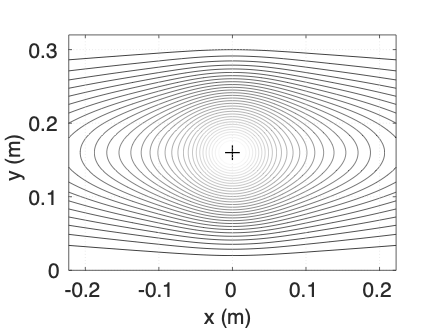
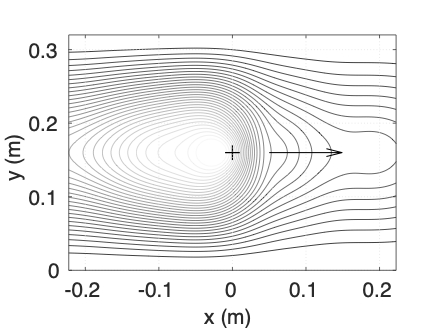
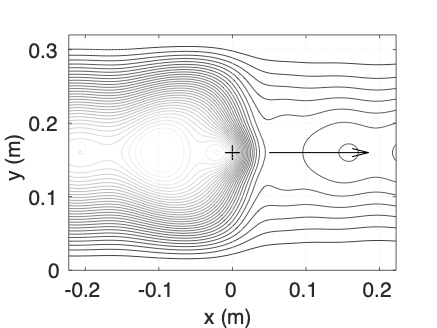
In the following figure is shown the map of vibrational energy for various rolling speeds. We observe that at \(V=0\) the distribution of energy is symmetrical. But when the speed increases, an accumulation of vibrational energy occurs in front of the moving force.
Distribution of vibrational energy at 200 Hz versus rolling speed at \(V=0\) km/h, \(V=90\) km/h, and \(V=216\) km/h.
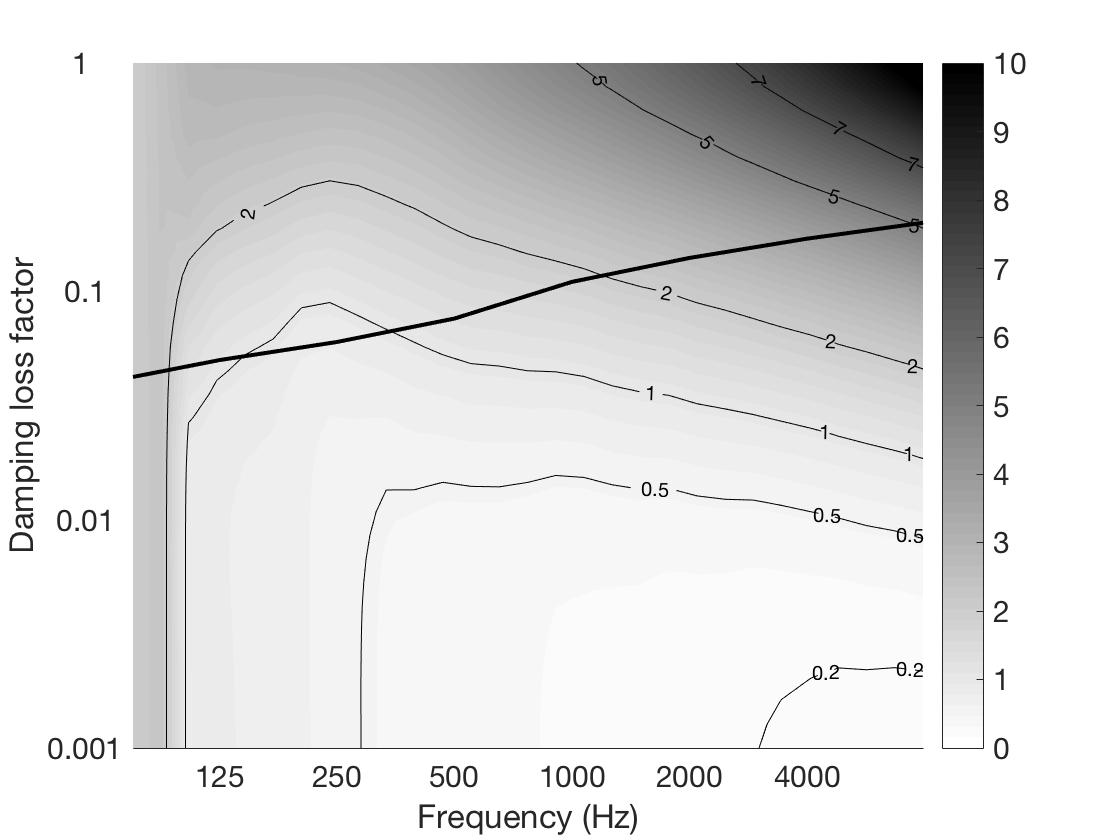
To observe the spatial distribution of the vibrational energy under a random force, we adopt the same method as in this page (see Domain of validity). We apply a single random force whose power spectral density is flat in an octave band. The governing equation is solved by a modal development approach for various damping loss factors and octave bands. The field of vibrational energy is then computed in 10000 points and we calculate the standard deviation of energy divided by the mean value. This is a dimensionless factor which represents the percentage of spatial fluctuations with respect to the mean.
Standard deviation of spatial fluctuations of energy in the frequency - damping plane for a tyre excited by a random force in an octave band. Solid black line: damping for an actual tyre.
In the above map, the zone of diffuse field for which the spatial distribution is the most uniform, is under the isovalue line 0.3. But if we take a real tyre, its damping loss factor is about 10 % and increases with frequency (solid black line in the map). This black line indicates that the wavefield in a tyre is never in the region of diffuse field. It starts from the region where the modal behaviour dominates (left side of the map) and arrives in the region where the direct field dominates (uppr right side of the map).
-
A. Le Bot, Z. Bazari, P. Klein, J. Lelong. Statistical analysis of vibration in tyres, J. Sound Vib., 392, 187--199, 2017.
-
A. Le Bot, G. Duval, E. Klein, and J. Lelong. Analytical solution for bending vibration of a thin-walled cylinder rolling on a time-varying force, R. Soc. open sci., 5, 180639, 2018.